
What Yesterday’s 2,704 Pages Do to Your Hospital
Starting in 2028, Medicare puts your joint replacement and the next 90 days into one bill.

Today’s brief runs without a paywall. The rule landed yesterday. Hospitals need this before Monday. Everything below normally sits behind the subscriber wall.
Rojas Actual.
The knee you did Tuesday is already in the file.
So is the one from March. So is every joint replacement your hospital has done since January 2024.
Medicare is using those cases to build the target price your hospital will be judged against starting in 2028. Every case you do between now and December still feeds that calculation.
CMS finalized the model yesterday.
Nobody called to tell you CMS started building your benchmark two and a half years ago.
IN TODAY’S ARTICLE:
What Medicare is about to start measuring, explained with one patient.
Whether this applies to your hospital.
When your hospital can owe money, and the most your hospital can lose.
What CMS said about physician ownership, and why that part outlives the payment model.
Glossary at the bottom of today’s article.
WHAT MEDICARE DOES WITH THE NUMBER
Here is what Medicare will do with the number it is building.
A 71-year-old woman comes to your hospital for a total knee. You do the case. She goes home on day two.
Today, Medicare mostly treats the surgery and the care afterward as separate bills. Your hospital gets paid for the admission. The rehab facility bills separately. The home health agency bills separately. Her follow-up visits bill separately.
Starting January 1, 2028, Medicare puts the surgery and the next 90 days into one financial episode.
Everything spent on that patient during those 90 days goes into one number. The rehab stay. The home health nurse. Physical therapy. Follow-up imaging. If she falls in week six and shows up in an emergency room, that visit counts. If she gets readmitted, the whole readmission counts.
One surgery.
One number.
Ninety days of consequences you mostly do not control.
HOW YOUR HOSPITAL WINS OR LOSES
The mechanism is simpler than it sounds.
Before the year starts, CMS sets a target price for a joint replacement episode.
Your hospital does its cases. Medicare adds up what actually got spent on each one across the full 90 days. After the year ends, CMS compares the two.
Come in below the target while meeting the quality requirements, and your hospital can receive money. Come in above it, and your hospital can owe Medicare. That comparison has a name. Reconciliation. Everything else in this model exists to move that one number.
Now understand when the risk starts.
Numerous commenters asked CMS to make the first performance year upside-only, so hospitals could learn the model before owing anything. CMS declined. The rule states that an upside-only first year is not necessary or appropriate for CJR-X.
CMS did not remove downside risk. It delayed the start of the model, moving it from October 1, 2027 to January 1, 2028. Those are different decisions.
Your hospital carries downside risk from the first performance year. What CMS granted was preparation time. Now sit with what that means clinically.
Most surgeons reading this have never managed a skilled nursing facility relationship. The rehab facility that keeps your patients an extra nine days has never cost your hospital a dollar.
In 2028, it costs you directly, and you likely have no contract with them, no leverage over them, and no current visibility into which facilities your patients go to after discharge.
The model has a name. Comprehensive Care for Joint Replacement Expanded, which CMS shortens to CJR-X. It covers hips and knees only.
DOES THIS APPLY TO YOUR HOSPITAL?
If your hospital performs Medicare hip or knee replacements, assume this applies until your team confirms otherwise.
CMS wrote the participation rule as one sentence. Any acute care hospital in the country that performs lower extremity joint replacements and holds eligibility for payment under both the inpatient and outpatient Medicare payment systems participates.
Then CMS wrote the exceptions. There are two.
Hospitals already participating in a different Medicare surgical payment model called TEAM. Hospitals located in Maryland.
That is the complete list.
Read it again and look for physician ownership.
Look for bed count.
Look for whether you operate an emergency department.
Look for specialty focus.None of it is there.
That matters more than it sounds.For sixteen years, physician ownership has been the thing that determined your hospital’s legal treatment. Section 6001 of the Affordable Care Act froze physician-owned hospitals at whatever beds, operating rooms, and procedure rooms they were licensed for on March 23, 2010. Ownership was the entire question.
One clarification, because it will come up with your billing team. Some hospitals hold eligibility under the outpatient payment system without billing much outpatient volume. CMS addressed that during finalization and said eligibility governs, not actual billing.
In this participation rule, ownership is not a question at all.
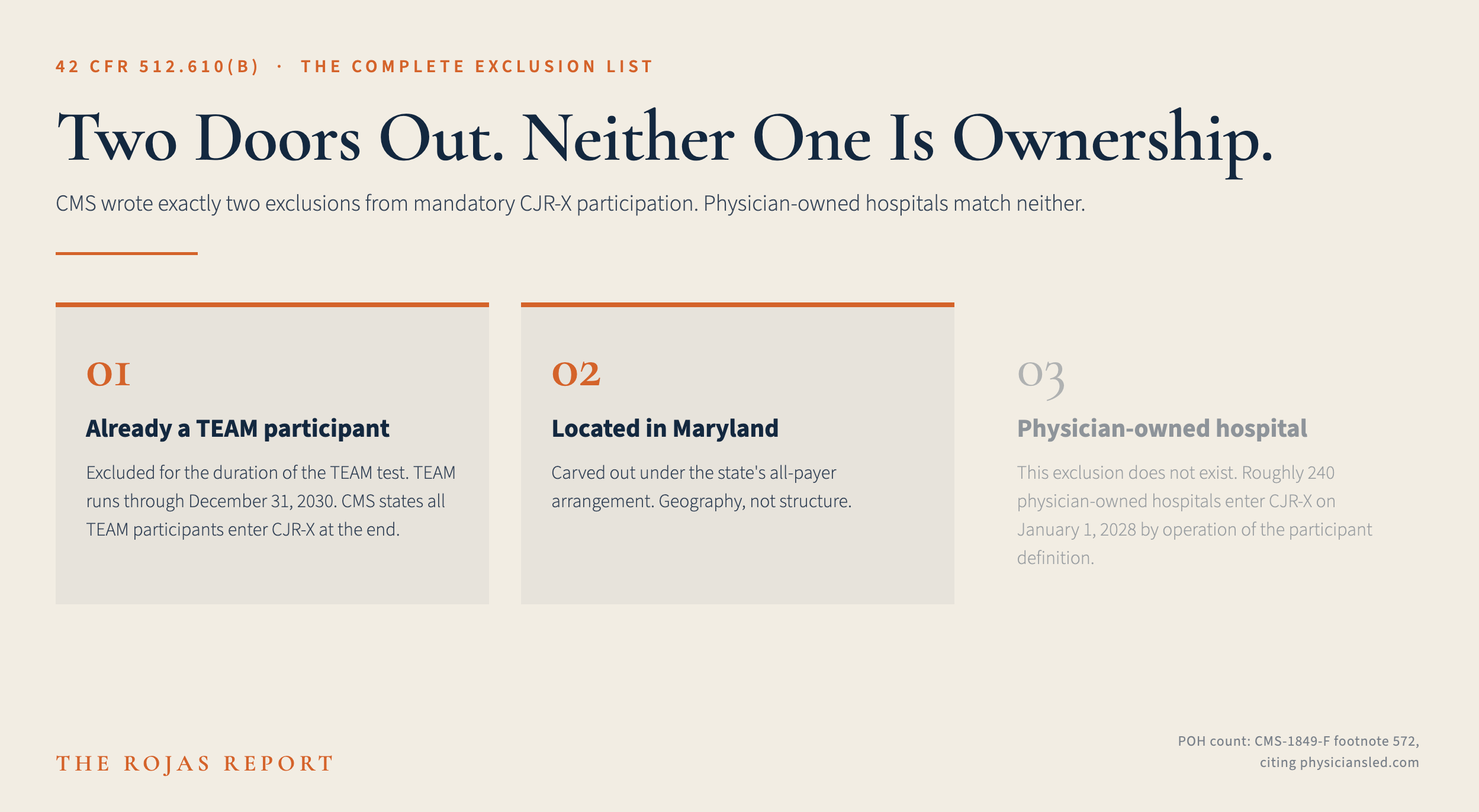
Participant definition at 42 CFR 512.605. Exceptions at 42 CFR 512.610(b).
This one is outside the wall because the clock is short.
The next one will not be.
100,000 readers per month: physicians, healthcare executives, and lawmakers. The ones who pay keep it independent.
THE NUMBER 31
Here is the one figure you can pull today.
CMS wrote a volume floor into the rule. For a performance year, if CMS finds fewer than 31 joint replacement episodes in the applicable baseline period, it establishes no target price and runs no reconciliation for that hospital.
Be careful with what that does and does not mean.
Falling under 31 does not remove your hospital from the model. Your hospital still participates. What changes is that no target price exists and no settlement happens, so no money moves in either direction for that year.
Participation and financial settlement are two different things. Do not let anyone in your organization conflate them.
The baseline period for the first performance year runs January 1, 2024 through December 31, 2026.
Two of those three years already sit in your billing system. Someone on your team can count them this afternoon.
If you are well above 31, your hospital carries financial exposure, and you have eighteen months to build post-acute relationships you probably do not have today.
If you are near 31, that number is the most consequential figure in your hospital right now, and volume decisions you make this quarter move it.
If you are well below 31, count it, document it, and check it again each year. The floor applies per performance year, not once.
Nobody is going to run this number for you.
Low-volume exception at 42 CFR 512.545(a)(4).
Baseline period at 42 CFR 512.545(b)(2).
THE OTHER MODEL, AND THE CHOICE COMING
CMS already runs a second surgical payment model called TEAM. It works through the same basic mechanism, with two differences that matter.
TEAM covers five categories of surgery instead of one. Joint replacement, spinal fusion, coronary artery bypass, major bowel procedures, and surgical hip and femur fracture treatment.
And TEAM follows the patient for 30 days after discharge. CJR-X follows the patient for 90 days. Today, TEAM is mandatory only for hospitals in geographic areas CMS selected. Some physician-owned hospitals landed inside those areas.
In April, CMS asked whether physician-owned hospitals outside those areas could volunteer to join. Comments closed in June. Yesterday CMS answered. The agency said it intends to propose a voluntary participation policy in future rulemaking.
Read that carefully. Intends to propose. No opt-in policy exists yet. CMS must publish a proposed rule, take comments, and finalize terms before any hospital can act on it.
That proposal would not unfreeze a single bed, operating room, or procedure room. CMS said it holds no authority to amend, modify, or repeal the statute. Section 6001 stands.
What it would create is a choice between two models.
Same hip. Same knee.
Sixty days of difference in how long Medicare keeps counting.Most people will assume a 30-day window removes two-thirds of the risk. Maybe.
Episode spending tends to cluster early, in the days right after discharge. Your own claims already hold the answer for your hospital.TEAM measures 30 days. CJR-X measures 90.
The shorter window does not remove two-thirds of the risk.
WHAT YOUR HOSPITAL CAN ACTUALLY LOSE
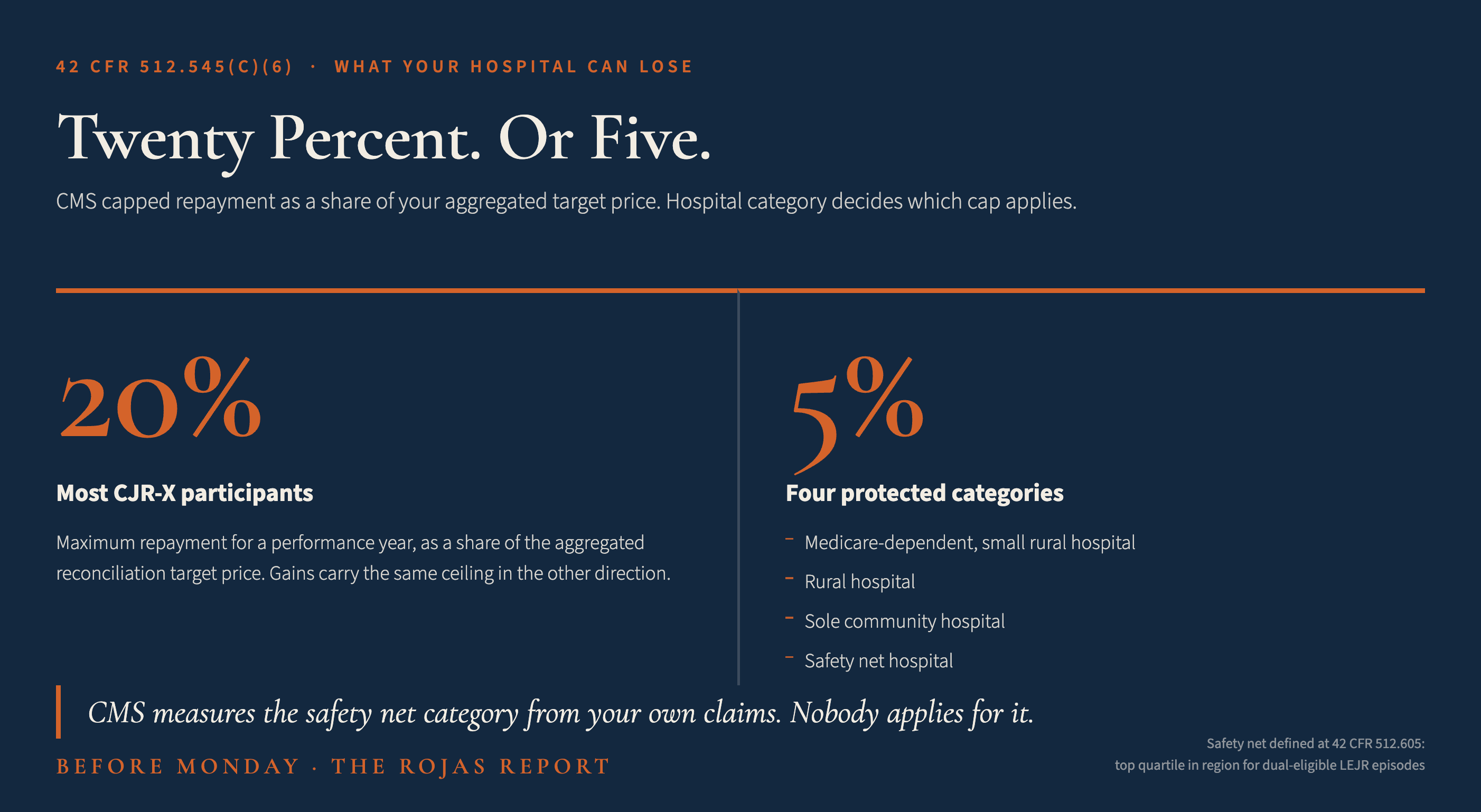
To understand what your hospital can actually lose, you need two numbers: 20 percent and 5 percent. One applies to most hospitals. The other applies only if your hospital falls into one of four protected categories.
CMS capped repayment. For a CJR-X participant, the amount owed back for a performance year cannot exceed 20 percent of the aggregated target price for that year. That is the ceiling. Not 20 percent of revenue, not 20 percent of margin. Twenty percent of what CMS said your episodes were supposed to cost.
Then CMS wrote a second, lower cap at 5 percent for four categories of hospitals.
Medicare-dependent small rural hospitals. Rural hospitals, meaning an inpatient hospital located in a rural area or a rural census tract. Sole community hospitals. And safety net hospitals, which CMS defines here as hospitals in the top quarter of their region for the share of joint replacement episodes furnished to dual-eligible beneficiaries during the baseline period.
Check that last one carefully. It is not a designation your hospital applies for. CMS measures it from your own claims. A physician-owned hospital serving a heavily dual-eligible population may already qualify and not know it, which cuts its maximum exposure by three-quarters.
Gains carry the same 20 percent ceiling in the other direction.
Now combine the caps with the window, because that is where the real answer sits.
A 30-day model and a 90-day model both settle against a target price, and both cap at the same percentage of that target price. What the longer window changes is how often your hospital pushes against the cap, not how far it can fall in a single year. The window drives frequency of loss. The cap drives magnitude.
A hospital with strong post-acute discipline may never approach either ceiling under 90 days. A hospital that discharges to whichever facility has a bed may hit the cap repeatedly, and the shorter TEAM window would help it substantially.
That is the actual test. Not which window is shorter. Whether your hospital’s spending clusters in the first 30 days or spreads across all 90.
You can answer that today from your own claims. Here is the analysis.
Pull every Medicare joint replacement episode your hospital initiated between January 1, 2024 and today.
For each one, take total Medicare spending across all settings for 90 days after discharge, not just what your hospital billed. Bucket that spending by day.
Then plot the cumulative curve.
Read the shape.
If the curve reaches most of its total by day 30 and flattens, the extra sixty days of CJR-X exposure costs you very little, and a TEAM opt-in buys you almost nothing.
If the curve keeps climbing through day 60, those sixty days are where your money goes. A TEAM opt-in becomes the most valuable item on your regulatory calendar, and your post-acute network is the thing to fix first.
If the curve is flat but your outlier cases have long tails, your problem is not the network. It is a handful of patients, and you can name them.
Most hospitals have never run this. The data has been sitting in their claims for two and a half years. Now you know whether thirty days is worth anything to you.
Stop-loss and stop-gain limits at 42 CFR 512.545©(6). Protected category definitions at 42 CFR 512.605.
Eighteen months to fix a post-acute network.
Or one reconciliation to find out what it cost.
Nobody funds this work except the readers.
WHAT CMS PUT ON THE RECORD
There is one more thing in yesterday’s rule worth your attention, and it has nothing to do with payment.
For sixteen years, the argument against physician-owned hospitals has been the same. You take the young, healthy, well-insured patients. You skip the hard ones. You avoid emergency obligations. You drain the community hospital down the road.
Somebody filed that entire argument in the comments. All of it. The readmission penalty statistics, the rural margin claims, the emergency service comparison.
CMS wrote its answer in the Federal Register.
The agency said it takes those concerns seriously. Then it said it does not agree they require rejecting participation. It does not agree that voluntary participation by itself permits cherry-picking or steering. It does not agree that a focus on profitable service lines justifies excluding otherwise eligible physician-owned hospitals.
Look at what CMS proposes to do instead of excluding.
Monitor case mix. Monitor referral patterns. Monitor admission sources, transfer patterns, readmissions, and outlier spending. Act if the data shows a problem. Remove a participant if it comes to that.
Yesterday, the agency confronted the stated risks of physician ownership and reached for monitoring, data, and remedial action rather than categorical exclusion.
Every one of those regulates what a hospital does.
Section 6001 regulates who owns it.
The rule changes nothing about your beds.
It changes something about the record.
Next Saturday: the second number, and what a post-acute network costs to build from nothing.
Run the curve first. Some of you will find it flattens by day 30, and you can stop reading about this model. Some of you will find it climbing at day 60, and you will be looking at a network you do not have, a contract you have never negotiated, and eighteen months.
That second group has a bigger problem than a newsletter solves.
Find out which group you are in this week.
-Rojas out.

AUTHOR DISCLOSURE:
Dutch Rojas is the founder of The Rojas Report, the owner and operator of multiple healthcare companies, and a member of the Board of Directors of Physician Hospitals of America (PHA). He does not hold a direct ownership interest in any hospital.
GLOSSARY
Episode: Everything Medicare spends on one patient from surgery through a set number of days after discharge, added into a single number.
Target price: The number CMS sets before the year starts as the benchmark for an episode.
Reconciliation: The settlement after the year ends. CMS compares actual spending against the target price and money moves in one direction or the other.
Stop-loss: The cap on how much a hospital can owe Medicare after reconciliation in a single performance year.
CJR-X: Comprehensive Care for Joint Replacement Expanded. Nationwide, mandatory, hips and knees only, 90-day episodes, starting January 1, 2028.
TEAM: Transforming Episode Accountability Model. Five surgical categories, 30-day episodes, currently mandatory only in geographic areas CMS selected. Runs through December 31, 2030.
Section 6001: The 2010 Affordable Care Act provision that froze physician-owned hospitals at their March 23, 2010 licensed beds, operating rooms, and procedure rooms, and closed the door on new ones.
Baseline period: The historical window CMS uses to count your episodes and build your target price. For the first CJR-X performance year, January 1, 2024 through December 31, 2026.
Dual-eligible beneficiary: A patient covered by both Medicare and Medicaid.
SOURCES
The rule itself
Centers for Medicare & Medicaid Services. Hospital Inpatient Prospective Payment Systems for Acute Care Hospitals and the Long-Term Care Hospital Prospective Payment System and Policy Changes and Fiscal Year 2027 Rates. CMS-1849-F. Displayed for public inspection July 31, 2026. Federal Register publication August 4, 2026.
Read it here: https://www.federalregister.gov/d/2026-15833
That permalink appears on page one of the document itself and goes live on publication. Until then the display copy sits on the Federal Register public inspection desk.
The provisions cited in this article
CJR-X participant definition and protected hospital categories: 42 CFR 512.605
CJR-X exclusions: 42 CFR 512.610(b)
Low-volume exception and baseline period: 42 CFR 512.545(a)(4) and (b)(2)
Stop-loss and stop-gain limits: 42 CFR 512.545(c)(6)
Monitoring and remedial authority: 42 CFR 512.592 and 512.596
These sections are new. CJR-X sits in a new subpart F of part 512 and takes effect October 1, 2026, so none of it appears in the Code of Federal Regulations yet. Until it does, the rule text linked above is the only place to read it.
TEAM, which is already in force
TEAM took effect January 1, 2026, so its regulations are live and readable now.
Subpart E in full: https://www.ecfr.gov/current/title-42/chapter-IV/subchapter-H/part-512/subpart-E
TEAM definitions at 42 CFR 512.505: https://www.ecfr.gov/current/title-42/chapter-IV/subchapter-H/part-512/subpart-E/subject-group-ECFR3752b6db9419a65/section-512.505
Where the physician ownership questions started
CMS opened the Request for Information in the FY2027 proposed rule, published April 14, 2026. The eight questions CMS asked are worth reading against the answers it gave.
The count of physician-owned hospitals
CMS put the number above 240 and cited it, at footnote 572, to Physician-Led Healthcare for America.
https://physiciansled.com/physician-led-hospitals-2/
Worth noting who counted. The federal government relies on the sector’s own tally because no other tally exists.
CMS rule pages
Acute Inpatient PPS: https://www.cms.gov/medicare/payment/prospective-payment-systems/acute-inpatient-pps
The FY2027 final rule home page, which will carry the tables and impact files, has not posted yet. The proposed rule home page is here: https://www.cms.gov/medicare/payment/prospective-payment-systems/acute-inpatient-pps/fy-2027-ipps-proposed-rule-home-page