
Who Owns Your Hospital? Inside the 30-Day Takeover of Nebraska's Largest Health System
In January 2026, a public university paid $800 million to seize sole control of a $2.5 billion nonprofit health system. The board that opposed the deal was replaced. The lawsuit that challenged it was

There is a hospital in Omaha that generates $1.4 billion in net patient revenue. It employs over 10,000 people. It has more than 1,400 affiliated physicians. It is the state’s only Level 1 trauma center for adults and children. It has been named the best hospital in Nebraska for 14 consecutive years.
There is also a public university system operating on a $3 billion annual budget, with its flagship campus absorbing over $100 million in budget cuts over the past five years.
On January 2, 2026, the university announced it would buy the hospital.
By February 3, it was done.
IN TODAY’S ARTICLE:
How the University of Nebraska executed an $800 million acquisition of Nebraska Medicine in 30 days, ending a 30-year partnership with Clarkson Regional Health Services
The board of directors that sued to block the deal, calling it a “hostile takeover.” They were replaced within a week.
The $200 million circular “donation” that reduces the net cost while generating a tax benefit for Clarkson
The dual role of NU President Jeffrey Gold, who served as Nebraska Medicine’s board chairman for a decade before becoming the buyer
Why 32 state senators asked for a delay and what happened when they did
Glossary at the bottom of today’s article.
THE ANATOMY OF A 30-DAY TAKEOVER
The sequence matters. Every step in this transaction was designed to outrun opposition.
January 2, 2026. The University of Nebraska Board of Regents and Clarkson Regional Health Services publicly announced an $800 million deal. Under the terms, Clarkson will resign its 50% membership interest in Nebraska Medicine. NU will pay $500 million for Clarkson’s stake and $300 million for the land and buildings Clarkson owns near the University of Nebraska Medical Center campus. Clarkson will then donate $200 million to the university to fund “Project Health,” a $2.19 billion facility-replacement initiative. The parties negotiated the deal under nondisclosure agreements dating back to July 2024. Nobody outside the negotiating parties knew.
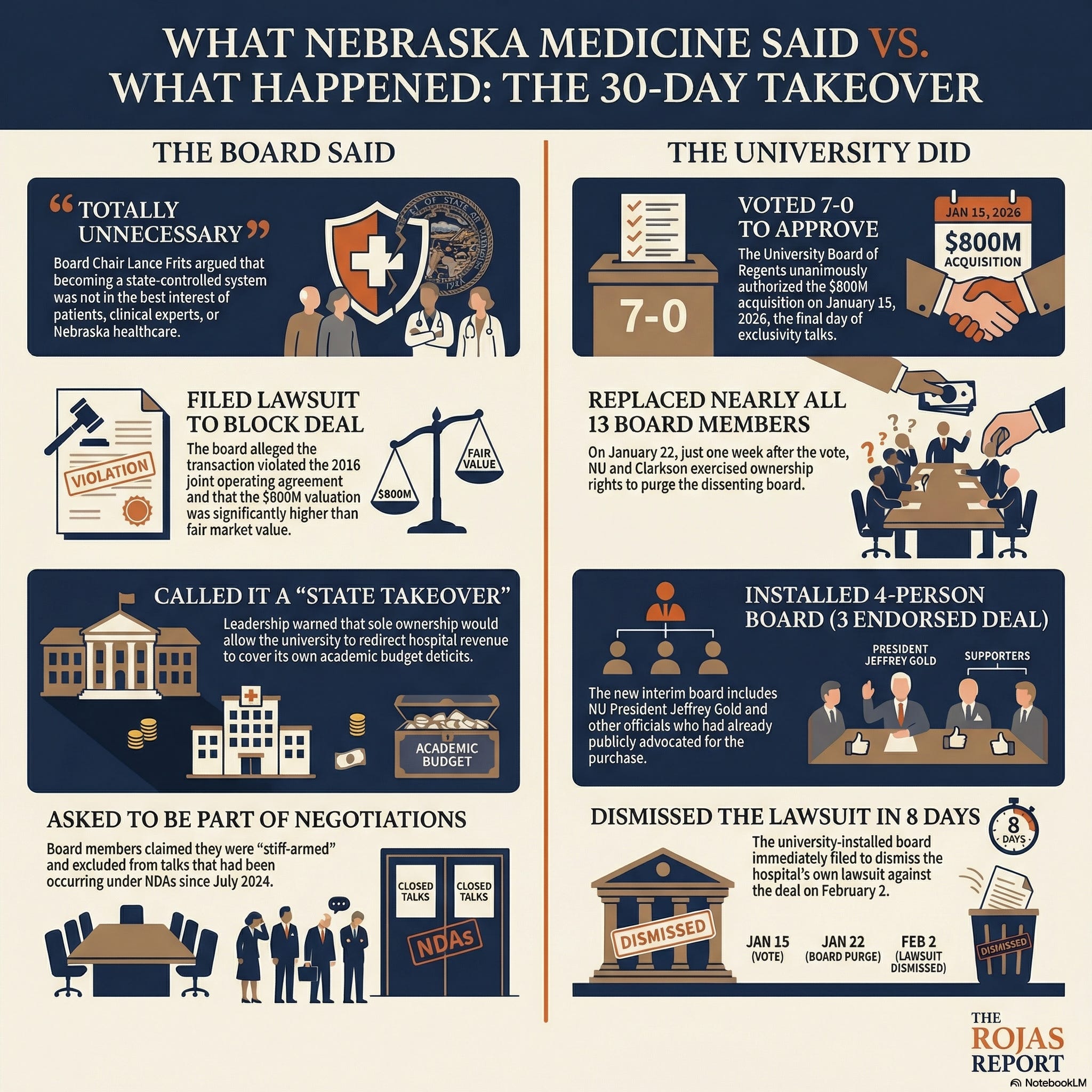
January 3, 2026. The Nebraska Medicine Board of Directors, chaired by Lance Fritz, issues a public statement opposing the transaction. Fritz calls it “totally unnecessary” and states that “becoming a state-controlled health system is not in the best interest of our patients, our clinical experts, and health care in Nebraska.” The board announces it will take all necessary actions to prevent what it calls a “state takeover.”
January 7-8, 2026. Thirty-two of Nebraska’s 49 state senators sent a letter to the Board of Regents asking them to delay the vote. The senators note that the deal was negotiated in secret for 18 months with “very limited visibility” for the public and the Legislature. The NU Board of Regents asks the Nebraska Attorney General to investigate the former Nebraska Medicine board for alleged lobbying against the deal. Members of the Legislature’s Appropriations Committee later deny being lobbied. Senator Machaela Cavanaugh says she feels used as a “political pawn.”
January 13, 2026. Three former Nebraska Medicine CEOs, Dr. James Linder, Dr. Dan DeBehnke, and Glenn Fosdick, publish an open letter opposing the deal. They write that Nebraska Medicine’s governance structure was “designed carefully and intentionally to honor close collaboration with our university partner, while protecting independence.” The guardrails, they write, were put in place specifically to prevent the kind of takeover now being proposed.
January 14, 2026. Nebraska Medicine and NU hold competing forums for state lawmakers. Lance Fritz tells senators that the board had “begged” to be part of negotiations but was “basically been stiff-armed.” NU President Jeffrey Gold says the opposite, that Nebraska Medicine negotiators had an “unwillingness” to return requests to connect. Dr. Beau Konigsberg, an orthopedic surgeon at UNMC, tells the Regents: “When decisions about healthcare compete with other priorities, patients ultimately bear the burden.”
January 15, 2026. The Board of Regents votes unanimously, 7-0, to approve the deal. The vote comes on the final day of exclusivity talks with Clarkson. NU officials say the transition will be complete by summer.
January 16, 2026. Nebraska Medicine files a lawsuit in Douglas County District Court to block the deal. The complaint alleges the transaction violates a 2016 joint operating agreement that requires mutual consent from all parties, including Nebraska Medicine, to terminate the partnership. The board argues that the $500 million for Clarkson’s stake is “highly overvalued” and that the $300 million for real estate “far exceeds fair market value.” Nebraska Medicine asks for a temporary restraining order.
January 22, 2026. The University of Nebraska and Clarkson exercise their authority as owners and replace nearly all 13 members of the Nebraska Medicine Board of Directors. The new interim board has four voting members: NU President Jeffrey Gold, Interim UNMC Chancellor Dele Davies, Clarkson CEO Bill Lydiatt, and Clarkson board member Stephanie Moline. Three of the four have publicly endorsed the deal. The four non-voting members are all UNMC officials. The people the lawsuit targeted now control the entity that filed it.
February 2, 2026. The newly installed board files to dismiss the lawsuit “without prejudice.” The judge accepts.
Thirty days. From public announcement to the elimination of all organized opposition. The health system that serves 1.23 million patients annually now has a governing board installed by its buyer.
You just read the setup.
The 30-day timeline.
The $800 million headline.
Paid subscribers get what's underneath.
The financial engineering.
The conflicts of interest.
The governance play that made it permanent.
Subscribe to The Rojas Report.
