
Why Physicians Belong on the Cap Table
Not just on the payroll. What I learned from the deals I missed, and the ones I didn't.

In 2009, I flew from New York to San Francisco to look at a few healthcare startups.
While I was in town, a friend invited me to sit in on a pitch.
Four guys.
A small room.
A strange idea.
People would rent air mattresses in strangers’ apartments.
I passed.
The company was Airbnb.
A year later, another opportunity came across my desk.
A colleague offered to sell me his shares in a startup at a small premium.
The pitch was simple enough: people would get into cars with strangers and trust them to drive safely.
I didn’t understand it.
I passed again.
That company was Uber.
A $50,000 check I didn’t write would be worth more than $100 million today.
I don’t tell you this to dramatize regret. I’ve done well. I spent over a decade building healthcare businesses, ambulatory surgery centers, medical practices, and real operating companies. Three early exits led me to build and invest in healthcare startups. And my last exit gave me the return to set up the next twenty years.
Three early investors saw returns that still make me proud:
$10,000 turned into $689,000 in 24 months.
$25,000 turned into $365,000 in 12 months.
$100,000 turned into $960,000 in 18 months.
I’ve built wealth.
I’ve returned capital.
I am not a cautionary tale.
But I am someone who sat in the room with some of the most valuable companies of our generation, and walked away. And these are just two of them, there are more...
The Actual Lesson
I didn’t pass on those deals because I was foolish.
I passed because I didn’t understand them.
Air mattresses in strangers’ homes sounded like a risk, not a business.
Getting into cars with people I didn’t know sounded like liability, not scale.
My skepticism wasn’t irrational.
It was misdirected.
Where I understood the business, including healthcare operations, reimbursement, physician incentives, and cost structures, I succeeded. Because I comprehended these dynamics, I consistently achieved positive outcomes.
When I invested in what I understood,
I created outsized returns.
When I didn’t understand the thesis,
I either passed or I should have.
That distinction matters.
Because most great investments don’t look obvious at the time, they look operational.
Messy.
Boring.
Unsexy.
They look exactly like the industries you already live inside.
The Physician’s Real Problem
Over the last few years, I’ve had the same conversation with physicians again and again.
“I never see these deals.”
“I only hear about them after they’re gone.”
“Private equity gets access. Venture capital gets access. We don’t.”
That’s true — but it’s incomplete.
Physicians aren’t just locked out of the best investment opportunities. They are structurally misused by them.
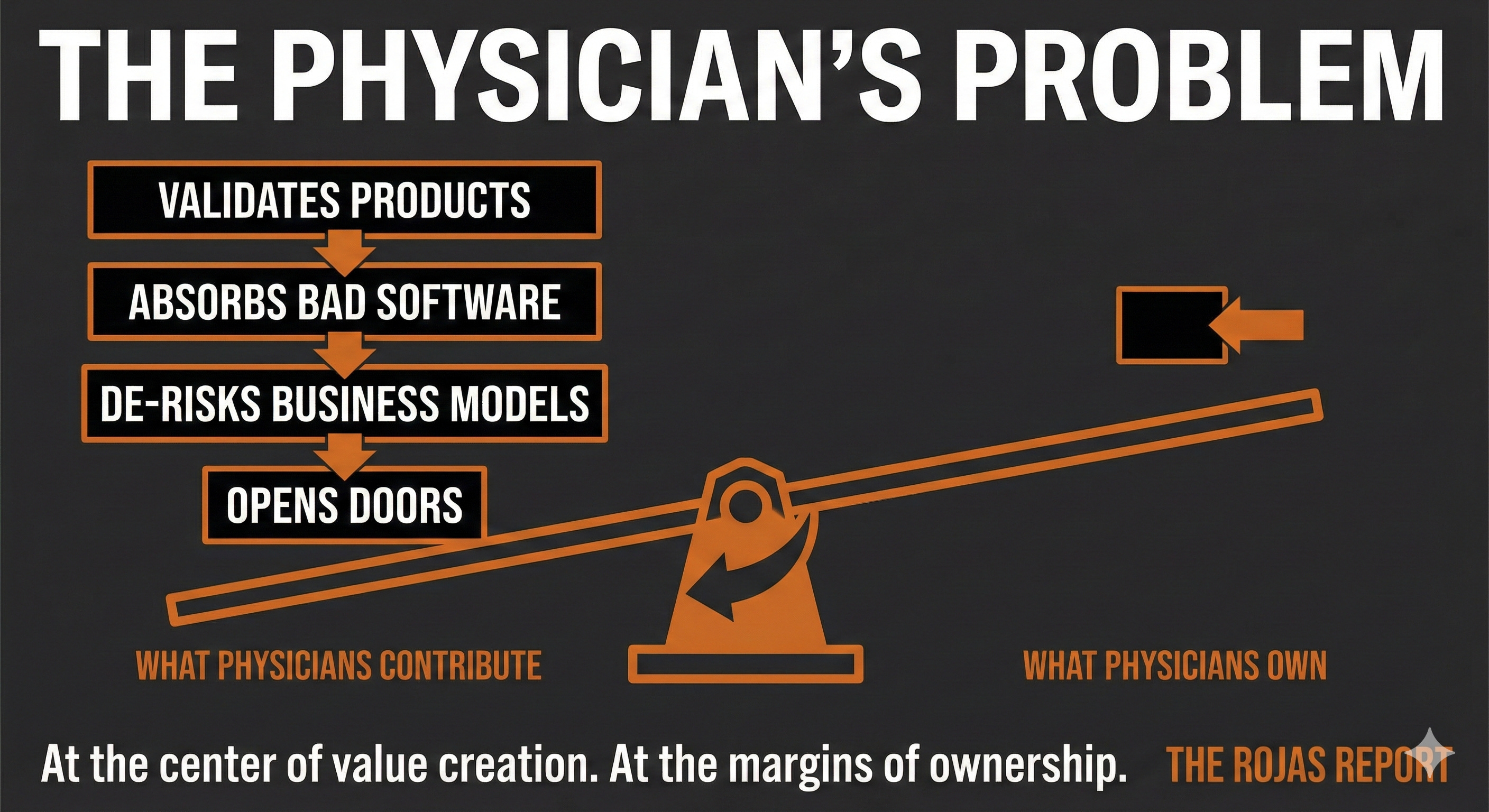
Every day, physicians subsidize the healthcare innovation economy without owning any of it.
Your clinical labor validates products. Your workflows absorb bad software. Your outcomes de-risk business models. Your credibility opens doors with hospitals and payers.
And when value is created, it accrues somewhere else.
This isn’t a failure of ambition or intelligence. It’s a failure of positioning.
Physicians sit at the center of healthcare value creation — and at the margins of healthcare ownership.
The Irony
Physicians possess one of the most powerful investment advantages in the world, and rarely deploy it.
When a healthcare startup pitches a traditional venture capitalist, they’re pitching someone who has never worked in an ICU, never negotiated a payer contract, never lived inside a broken workflow.
That investor builds spreadsheets.
Models TAM.
Chases trend narratives.
What they cannot do is distinguish between a product that sounds impressive and one that physicians will actually use.
You can.
You know which “innovations” create friction instead of relief. You know which dashboards get ignored. You know which products solve real problems — because you feel those problems every day.
That isn’t intuition.
That’s asymmetric information.
That’s alpha.
I passed on Uber because I didn’t understand getting into strangers’ cars.
You don’t have that problem in healthcare.
You already understand the risk.
You live with it.
The only question is whether you’ll ever get the chance to invest accordingly.
This is where the free preview ends. Paid subscribers get the full picture below.
