
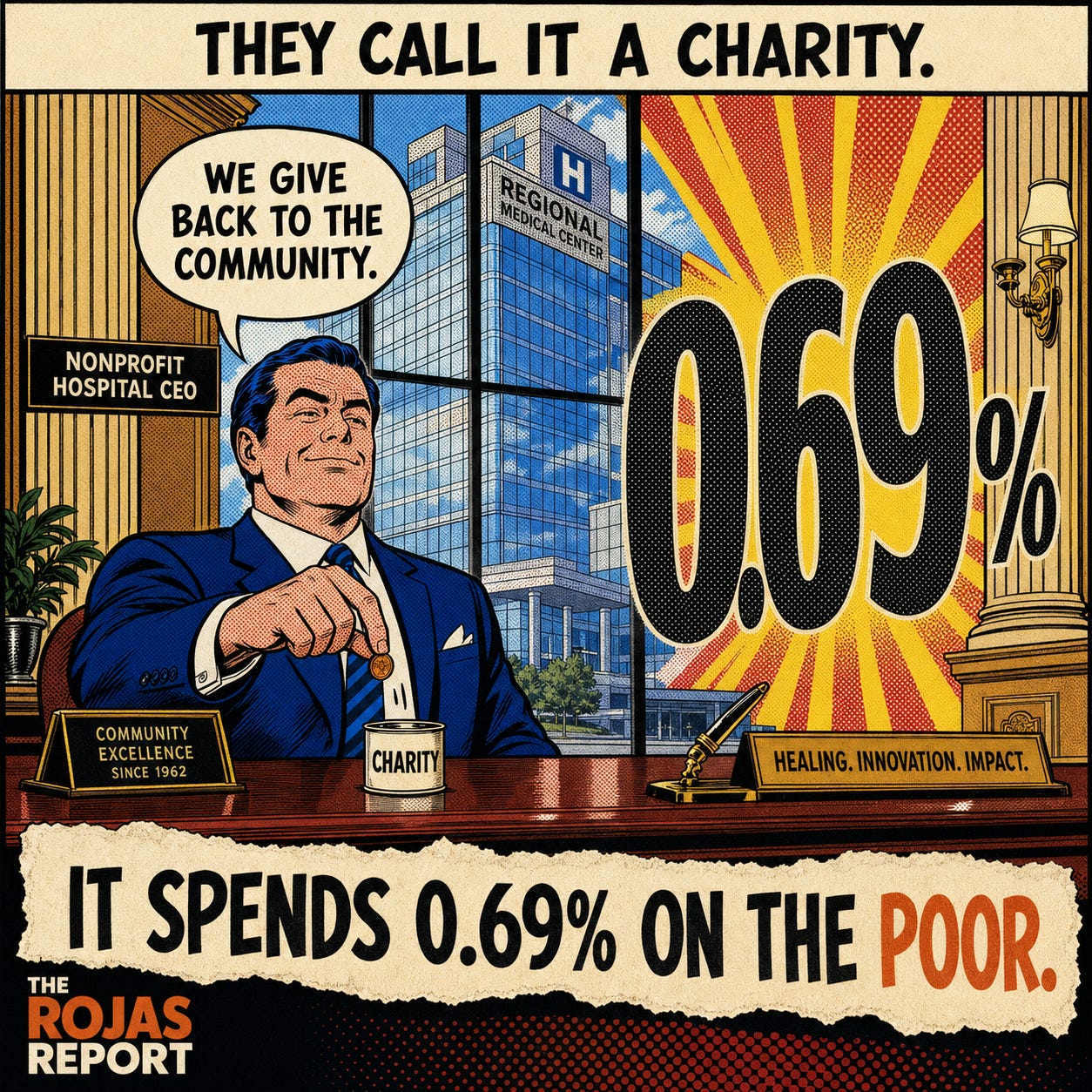
Yale New Haven Spends 0.69% of Its Budget on Charity Care. Where the Rest Goes Is the Real Story.
The bonds, the untaxed real estate, the executive payouts. Every advantage is legal. That is the problem.

Strip away the tax exemption, and Yale New Haven Health is a $7 billion corporation.
Strip away the charity claim, and it spends 0.69 percent on the poor.
Strip away the nonprofit filing, and you find a billion dollars in tax-free bonds, a half-billion-dollar building project, and a $ 23 million CEO payout.
There is nothing left to strip.
That was always the business.
IN TODAY’S ARTICLE:
The “nonprofit” designation covers a seven billion dollar system that spent 0.69 percent of one hospital’s expenses on charity care.
Yale New Haven Health reports operating losses and blames Medicaid, then spends $464 million a year on construction and ends the year with $606 million in cash.
Tax-free bonds, property exemptions, 340B, and Disproportionate Share payments stack into a structural advantage no taxpaying competitor can match.
Connecticut premiums climbed 16.8 percent for 2026 while the largest system in the state collected its exemptions.
Glossary at the bottom of today’s article.
THE NUMBER THEY DO NOT PUT IN THE BROCHURE
In fiscal 2021, Yale New Haven Hospital spent 0.69 percent of its total expenses on charity care.
Read that again.
Not 6.9 percent.
Not even one percent.
Sixty-nine hundredths of a single percent.
This is an organization the Internal Revenue Service classifies as a charity. A 501(c)(3). Tax-exempt on the theory that it exists to serve a public so underserved that the rest of us agree to forgo the taxes it would otherwise owe. That is the deal. That is the entire justification for the exemption.
Now set the charity number against the size of the enterprise. Yale New Haven Health is Connecticut’s largest health system. It reported total operating revenue of $7.24 billion in fiscal 2024 and $7.58 billion in fiscal 2025. A charity does not operate at that scale. A Fortune 500 company does.
The Lown Institute, a nonpartisan think tank, runs the math the hospital lobby hates. It calculates each hospital’s “fair share” by comparing the value of its tax exemptions with the amount it spends on charity care and community investment.
When a hospital takes more in tax breaks than it gives back, Lown calls the gap a fair-share deficit. Yale New Haven Hospital ran a deficit of $ 7.08 million. Bridgeport Hospital, also in the system, ran 9.67 million. Westerly Hospital in Rhode Island ran a deficit of 4.5 million.
The system did not fall short of its charitable obligation by accident.
It is built to.
Your hospital’s CFO already knows exactly what 0.69 percent of goodwill costs. You are finding out right now.
The Rojas Report reaches 100,000 readers a month: physicians, healthcare executives, and lawmakers.
