
You Fund a $909 Billion Program. You Just Don’t Know It.
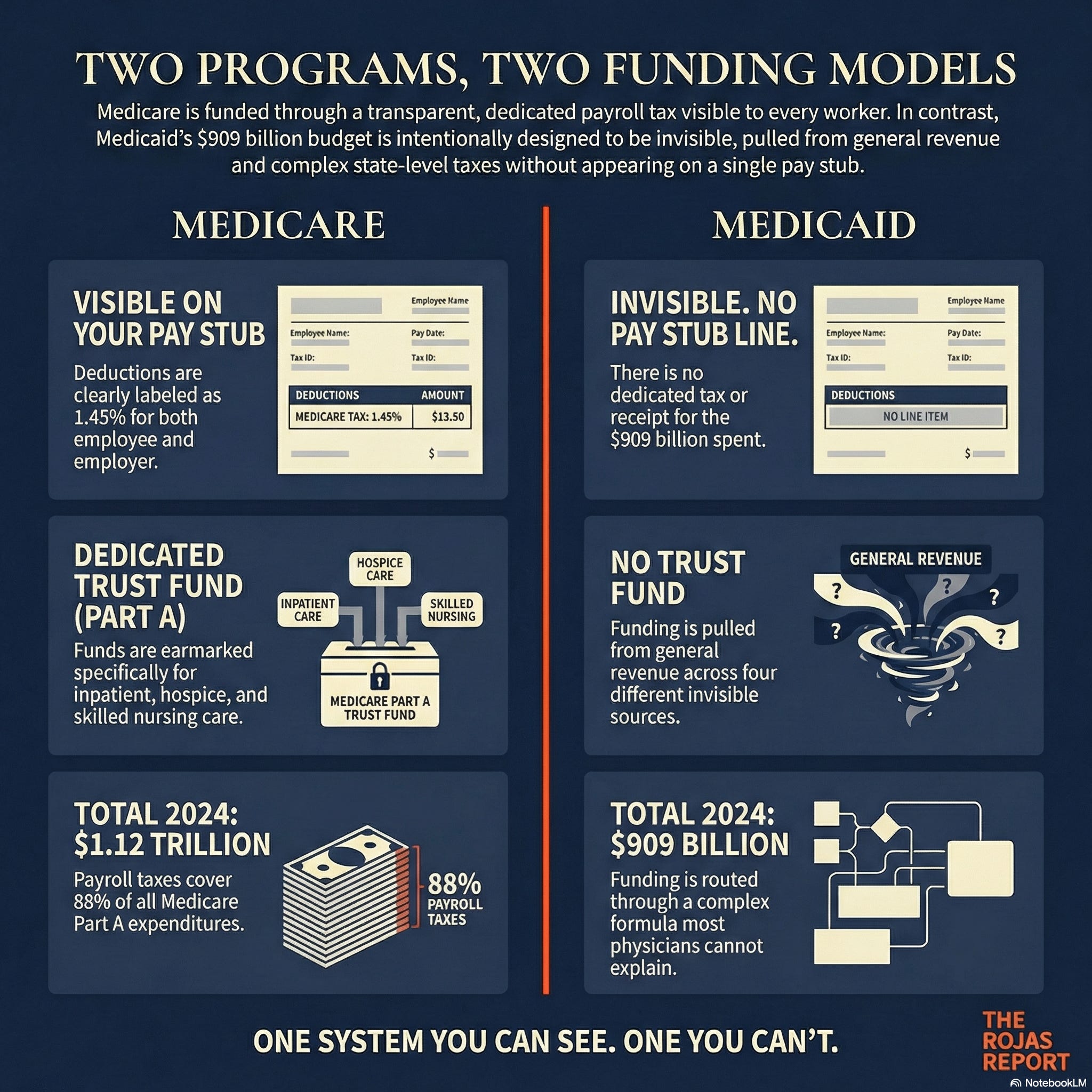
Medicare has a line on your paycheck. Medicaid doesn’t. That’s not an accident. That’s a design choice.

Last Friday, the Department of Health and Human Services (HHS) open-sourced the largest Medicaid claims dataset in its history.
10.32 gigabytes. Seven years of provider-level billing data. January 2018 through December 2024. Elon Musk called it transparency. Scott Bessent told whistleblowers they could get paid to find fraud.
We have spent the last few days discussing where the funds went. Now I will show you where it came from. I was in healthcare for more than a decade before I could fully understand it. And I do this for a living.
$909 billion left the U.S. Treasury last year for a single healthcare program. Not Medicare. That one’s on your pay stub.
This one isn’t.
No line item. No label. No receipt. Just general revenue. Your income taxes. Your state taxes. Routed through a formula most Americans have never heard of.
The program is Medicaid. And the money is yours.
IN TODAY’S ARTICLE:
HHS dropped seven years of Medicaid claims data on Friday. The conversation is about fraud. The conversation that matters is about funding.
You pay for Medicaid in at least four different ways. Federal income taxes, state income taxes, state sales taxes, and provider taxes on hospitals, nursing facilities, and MCOs. None of them appears as a line item on your paycheck.
A federal matching formula called FMAP turns every dollar of state Medicaid spending into two, three, or four federal dollars, and most taxpayers have never heard of it.
Medicaid home health spending hit $145.9 billion and is climbing. Friday’s data dump tells you who billed it. This article tells you who paid for it.
Glossary at the bottom of today’s article.
THE LINE ON YOUR PAY STUB
Open your last pay stub. Find the deduction labeled “Medicare.” That’s 1.45% of every dollar you earn, matched by another 1.45% from your employer. If you earn above $200,000, you pay an additional 0.9%.
That money goes to one place: the Medicare Hospital Insurance Trust Fund. Part A. It pays for inpatient hospital stays, skilled nursing, hospice, and some home health for Americans 65 and older and those with qualifying disabilities.
You can see it.
You can track it.
You know exactly what it funds and how much you paid.Total Medicare spending in 2024: $1.12 trillion.
The payroll tax covers 88% of Part A.
General revenue covers 71% of Part B.
Beneficiary premiums cover the rest.
Medicare is transparent by design. Congress gave it a dedicated payroll tax so Americans could see it, track it, and defend it politically.
Now find the line on your pay stub that says “Medicaid.”
You won’t. It doesn’t exist.
THE LINE THAT ISN’T THERE
Medicaid covers 83 million Americans. It is the single largest public health coverage program in the country. In fiscal year 2024, total Medicaid spending reached approximately $909 billion. Taxpayers, that’s you, fund the federal government, which paid roughly 65% of the cost. States, also funded by you, covered the rest.
None of it comes from a dedicated tax.
Every dollar of federal Medicaid spending comes from the U.S. Treasury’s general fund. The same pool of money that funds the military, pays interest on the national debt, builds highways, and runs federal prisons. Federal and corporate income taxes primarily fund it.
Every dollar of state Medicaid spending comes from state general funds. State income taxes. State sales taxes. And increasingly, a mechanism called the provider tax.
You pay for Medicaid in at least four ways.
You never see the receipt.
This is not an oversight.
When Congress created Medicaid in 1965, they made a deliberate choice: no dedicated payroll tax. No line item. No trust fund. Just general revenue, split between the federal government and 50 state governments through a formula that most Americans, most physicians, and most state legislators cannot explain from memory.
That formula is called the Federal Medical Assistance Percentage. FMAP.
THE FORMULA NO ONE EXPLAINS
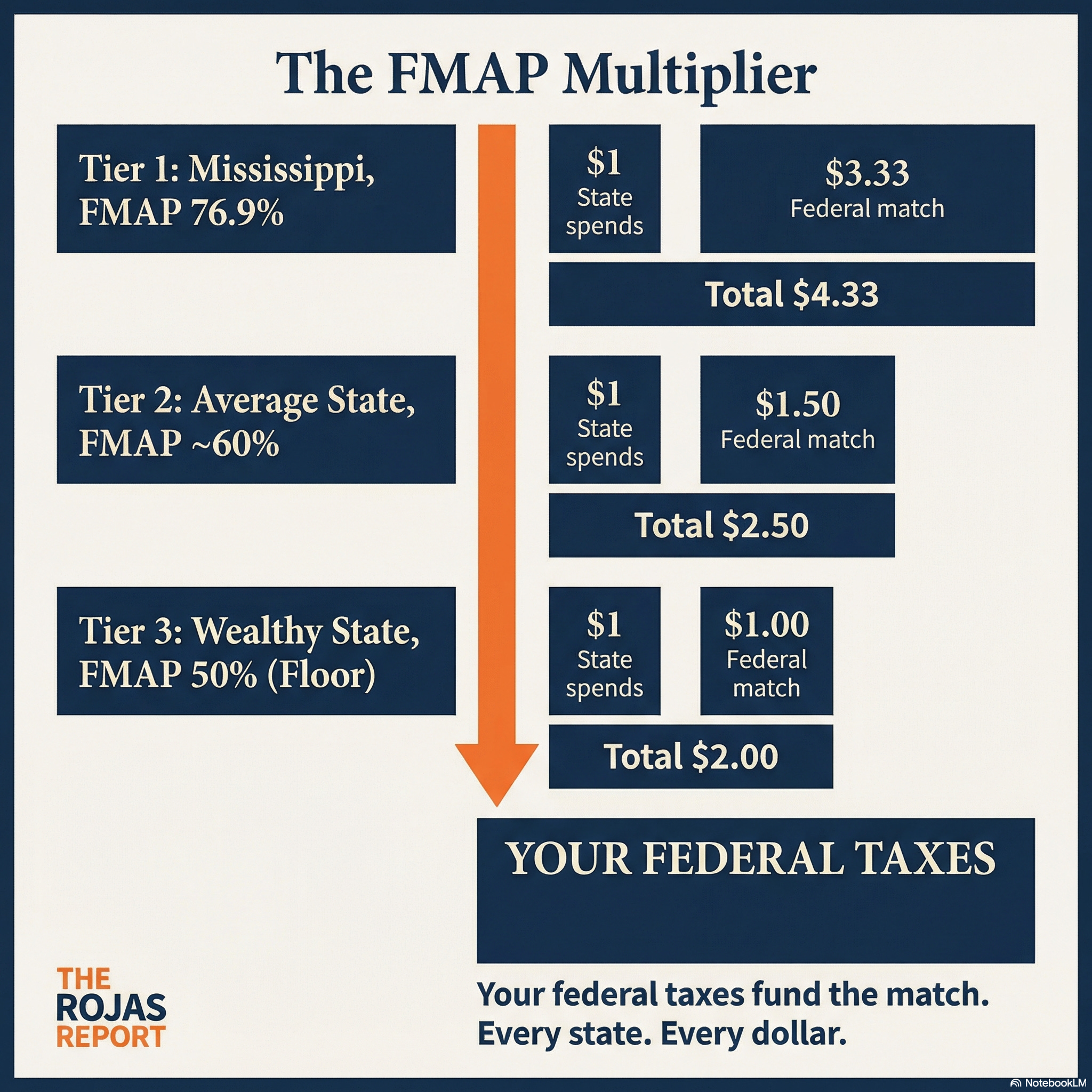
FMAP determines how much the federal government reimburses each state for every dollar of Medicaid spending. It varies by state and is recalculated annually based on per capita income relative to the national average.
The floor is 50%.
No state gets less than a dollar-for-dollar federal match, regardless of wealth.
The ceiling in FY2025: 76.9%.
That belongs to Mississippi.
More than three federal dollars are matched for every dollar Mississippi spends on Medicaid. For states like New York and California, the match hovers near the 50% floor, meaning the federal government still covers half.
The math creates an incentive. Every dollar a state spends on Medicaid is multiplied by federal matching funds. The poorer the state, the bigger the multiplier. And the federal dollars come from the same general revenue pool funded by taxpayers in all 50 states.
A Texas taxpayer helps fund Medicaid in New York.
A taxpayer in Florida helps fund Medicaid in Oregon.
The money moves.
The receipt never arrives.
The cartel counts on complexity to hide in plain sight. FMAP is Exhibit A.
THE PROVIDER TAX SCAM
There is a fourth funding channel most people miss entirely.
In most states, Medicaid is partially funded by taxes levied on hospitals, nursing facilities, and managed care organizations. These are called provider taxes.
The concept is straightforward. The state taxes entities that bill Medicaid. That tax revenue becomes state Medicaid spending. That state spending then gets matched by the federal government through FMAP.
Read that again.
The state taxes a hospital. Uses the tax revenue as its “state share” of Medicaid funding. Then collects the federal match on top of it. The hospital is reimbursed through Medicaid, which now includes federal matching dollars.
It is a money-laundering operation with a government seal. The state creates the illusion of spending its own money. The federal government matches it. The actual net cost to the state shrinks to almost nothing. The federal taxpayer covers the cost.
The Congressional Budget Office projects that supplemental and directed payments driven by provider tax schemes will add $85 billion to federal Medicaid spending over the next decade. H.R. 1, the One Big Beautiful Bill Act, seeks to rein in this by phasing the allowable provider tax rate from 6% to 3.5% by 2032.
But the structure remains intact. The full provider tax breakdown, including the seven states that ran a $24 billion scam, is here:

SUBSCRIBE:
Everyone is downloading 10 gigabytes of Medicaid data to look for fraud. Very few people understand the funding structure that enabled the fraud. This is where that conversation happens.
Subscribe Here.
