
Your Nonprofit Hospital Owes Charity. In 1969, the IRS Let It Stop.
Billions in tax breaks. No required charity since 1969. And the hospital grades its own homework.


Do you think a nonprofit hospital has to provide charity care?
It doesn’t.
The IRS deleted that requirement in 1969.
The tax break survived.
The charity became optional.
And the proof it offers in its place is graded by the hospital itself.
IN TODAY’S ARTICLE:
The charity number your hospital shows you is a number it gets to define, and the industry admits it.
In 1969, four years after Medicare and Medicaid were enacted, the IRS deleted the rule requiring free care.
The exemption is not a bargain it underpays. It is the cheap capital that buys your competition and bills you more for it.
The IRS has not stripped a single hospital of its exemption for failing to meet community benefit requirements in over a decade.
Glossary at the bottom of today’s article.
THE NUMBER THEY HAND YOU IS RIGGED
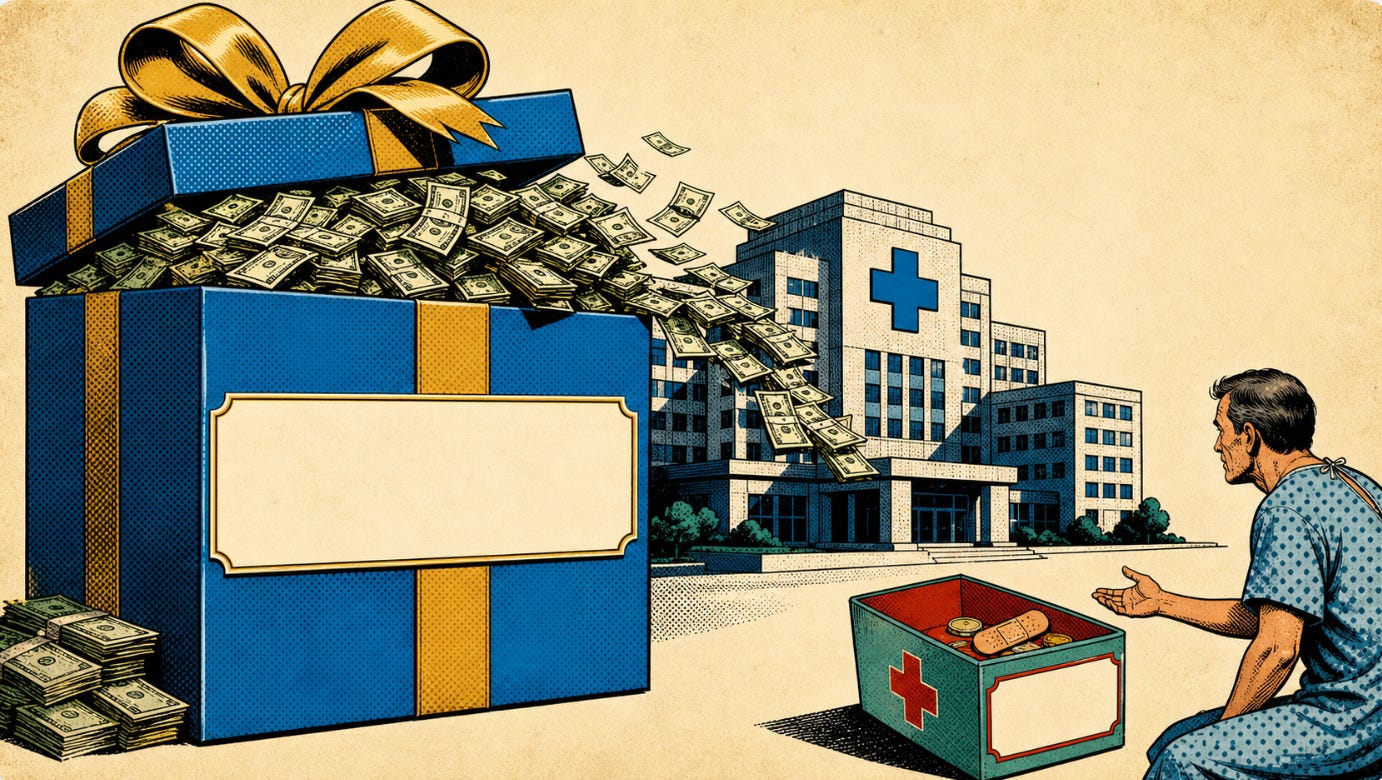
Ask a nonprofit hospital to justify its tax exemption, and it will not show you charity care. It will show you community benefit. A much bigger bucket.
In 2016, the industry reported community benefit at 13.7 percent of total hospital expenses. Roughly $76 billion in dollar terms. That is the number that ends up in the press release. It sounds enormous.
Look at what fills the bucket.
Free care to people who cannot pay is one line in it.
The larger pieces are something else.
The reported gap between what Medicaid paid and what the hospital says its costs were.
Health professions education.
Research.
Subsidized services.Each one is a real expense. None of them is the free care for the uninsured patient you pictured when you heard the word ‘charity’.
Now the part that matters.
The hospital determines its costs. It picks the costing method. It can run a cost-to-charge ratio off its own chargemaster or use its own cost accounting, and it reports the result on a form it fills out itself, using its own definitions.
When it books the gap between Medicaid’s payment and its stated cost as a community benefit, the hospital writes the cost side of that gap. It defines the numerator. It chooses the method. It grades its own paper.
You do not have to take my word for it.
Take theirs.
When the Lown Institute reported that most nonprofit hospitals receive more in tax breaks than they spend on patient care, the American Hospital Association’s Rick Pollack pushed back, arguing that the critics had left out the Medicaid and Medicare underpayments hospitals absorb.
Read that again. The industry’s answer to “you spend less on charity than your tax break is worth” is “you forgot to count the money we say the government underpaid us.” That is the self-defined number, raised as a shield.
Strip the bucket back to the honest measure. Free or discounted care, delivered to patients who cannot pay, counted at cost. That number was about $16 billion in 2020. The exemption that same year was worth about $28 billion.
The thing the public actually bought, the free care, is smaller than the break. The bigger number the hospitals wave is the one they get to build.
Everyone in healthcare has an opinion about nonprofit hospitals. Almost no one can show you how the charity number gets built.
The Rojas Report, led by accountants, show you where the receipts live, and this receipt is self-reported. Subscribe
