
Medicare Can’t Negotiate Drug Prices. The Man Who Wrote That Rule Got $2 Million.
The Medicare Modernization Act passed at 3 a.m. with the vote held open for three hours. The people who wrote it cashed out within a year. Here is the public record.

Previously in this series:
Part 1: There Is a Congressional Committee That Sets the Prices for Your Profession
Part 2: Fee-For-Service Inflation Was Not An Accident. One Man Designed It.
Part 3: The Four People Who Solicit Donations From the Healthcare System They Regulate
You think nobody negotiates your drug prices because it’s complicated.
It’s not complicated.
It’s illegal.
A committee staffer wrote the ban, then billed drug companies $6 million.
IN TODAY’S ARTICLE
Why the largest drug buyer in America is banned by law from negotiating prices.
The committee staffer who came from Eli Lilly wrote Part D, then billed drug makers roughly $6 million.
The CMS administrator who threatened the government’s own actuary to hide the cost from Congress.
The cooling-off rule that made every one of these cash-outs legal.
Glossary at the bottom of today’s article.
IT’S NOT COMPLICATED. IT’S ILLEGAL.
Most people assume Medicare does not negotiate drug prices because drug pricing is a tangle. Rebates, formularies, pharmacy benefit managers, list price versus net price. A maze too complex for any agency to fight through.
That is the cover story.
Here are the facts, and they are undisputed.
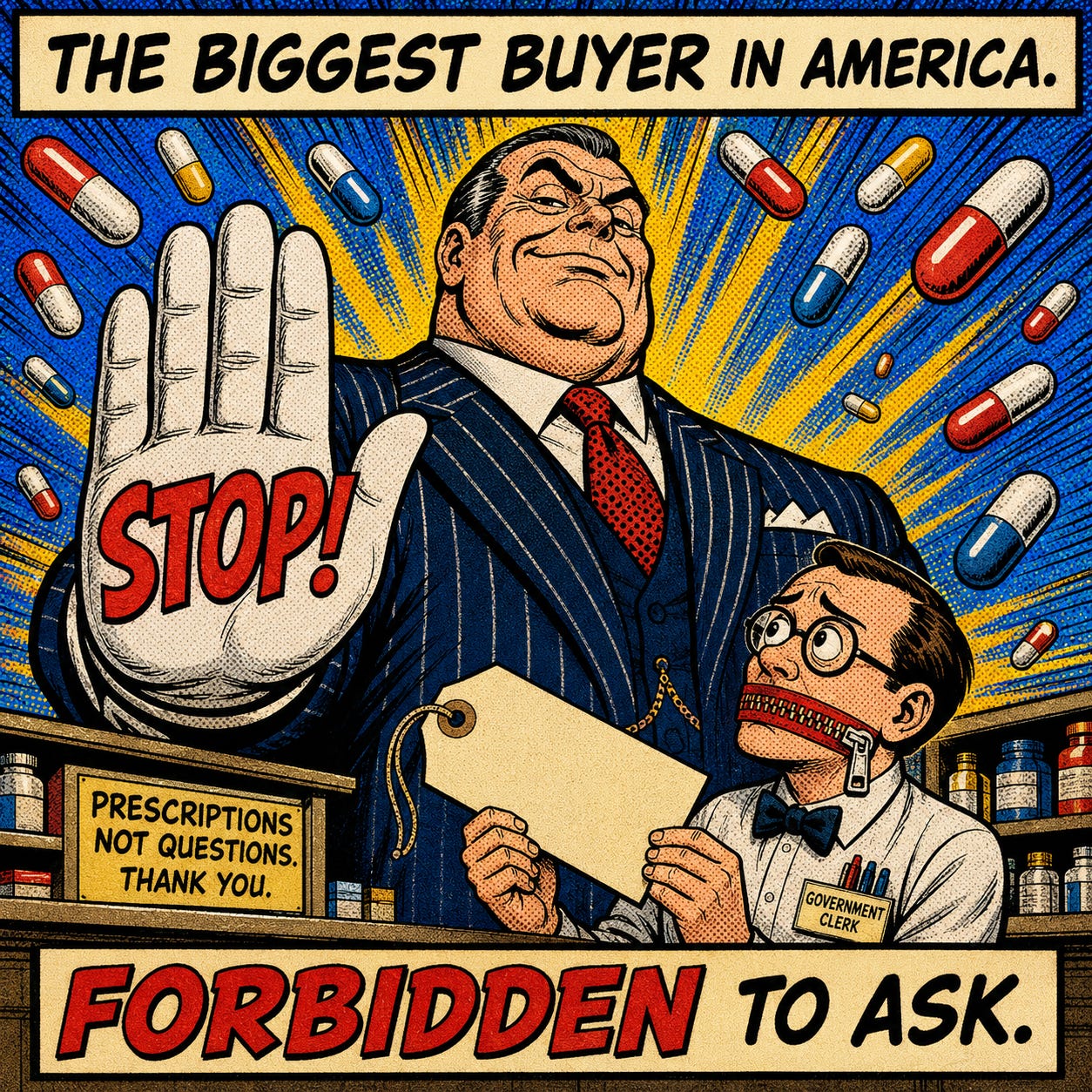
Medicare is the largest drug buyer in the country. By law, it is forbidden from negotiating the price of a single pill.
Not “discouraged.”
Not “limited.”
Forbidden.
A federal statute bars the Secretary of Health and Human Services from interfering in price negotiations between drug makers, pharmacies, and the private plans that run Part D. The same statute bars the Secretary from setting a formulary or any price structure.
So the biggest customer in the market walks in with the most leverage anyone has ever held, and the law ties its hands behind its back.
That clause has a name. The noninterference clause. It is contained in the 2003 Medicare Modernization Act, the law that created the Part D drug benefit.
Somebody wrote that sentence.
Somebody fought for it.
And the men who did got paid.
Every name, every dollar figure, every date below comes from the public record. The Office of Inspector General. ProPublica. NBC News. The congressional roll call.
The people who built the most expensive drug program in American history wrote themselves a private exit, then walked through it.
Lawmakers on powerful committees count on you believing this is too complicated to follow. That is the whole defense.
100,000+ physicians and healthcare operators read The Rojas Report because they refuse to be the last to understand who took the money.
