Washington Didn’t Give You Price Transparency. It Built a Fake Clock to Stop a Real One.
The federal mandate produces a number no patient can use, for a unit no one will define, posted by almost no one, punished almost never. That is not a bug. It is the product.


The Honest Market, Part II
Every honest price on earth shares one ingredient.
A flower lot has it.
A gallon of gas has it.
A hospital bill never will.It is not a number.
It is the thing the number describes.
And American medicine spends billions making sure that thing stays undefined.
IN TODAY’S ARTICLE
The one ingredient in every honest price, and the lobby that fights to keep it out of medicine
Why a machine-readable file is not a clock, no matter how many rows it has
The physician-owned models already publishing real prices, named.
What gets built when the people who deliver care own the place it gets priced
Glossary at the bottom of today’s article.
THE FAKE CLOCK
Last week, I took you to the Dutch Flower Clock. A descending price, in the open, on a unit everyone could see, owned by the people who grew the product. The most honest market on earth.
Now look at what Washington built when it claimed to give you the same thing.
The Hospital Price Transparency rule took effect January 1, 2021. Every hospital in America was ordered to post its standard charges, including payer-specific negotiated rates and a cash price, plus a consumer-friendly list of shoppable services.
Five years later, here is the box score.
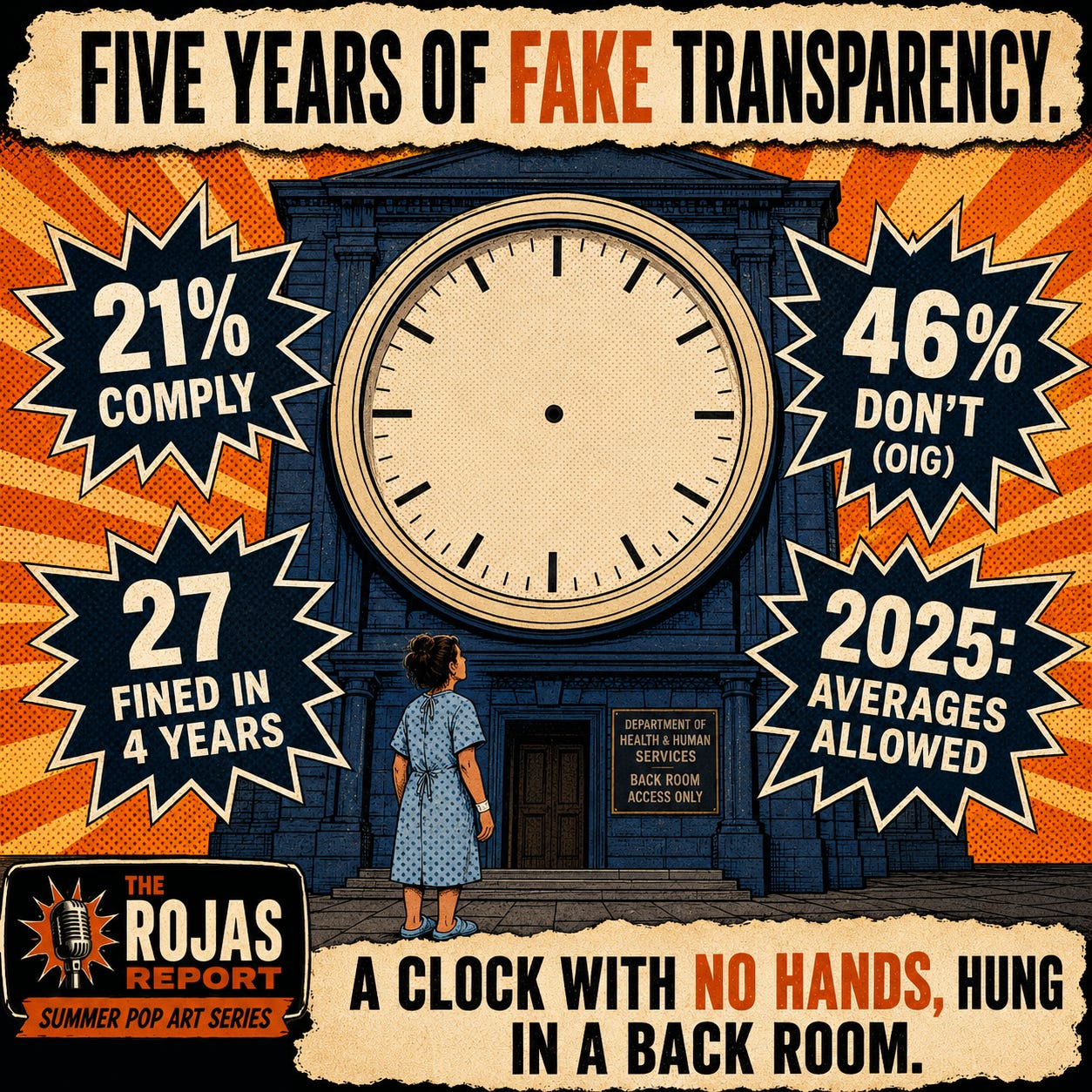
PatientRightsAdvocate.org, in its most recent semiannual audit, found that roughly 21 percent of 2,000 hospitals were fully compliant. The HHS Inspector General’s own 2024 audit estimated that 46 percent of hospitals were not fully compliant. The Government Accountability Office concluded the data quality was so poor that no one could use it at scale. And CMS, the agency holding the whip, has fined 27 hospitals over the past 4 years. Out of thousands.
That is not an enforcement failure.
That is the design.
It gets worse. Starting in 2025, CMS began allowing hospitals to post percentages, algorithms, and “estimated allowed amounts” (averages) in place of actual dollars-and-cents prices. The one rule that was supposed to force a real number now permits a blur. They legalized the fog.
And the American Hospital Association told on itself in writing. Its defense of noncompliance is that hospital pricing “does not translate easily into a single, fixed rate per service.” Read that again. The lobby is not arguing the price is hard to publish. It is arguing the price does not exist as a thing you can name.
That is the whole con, and it brings us to the ingredient.
There is a reason your hospital’s CFO already knows what your surgery costs and you do not. The people closing that gap publish here first.
👉 Subscribe to The Rojas Report.
WHAT A REAL PRICE REQUIRES
A price is not a number. A price is a number attached to a defined thing, available when you need it, from someone who wants you to see it. Strip any one of those three and the price means nothing.
Ingredient one: a defined unit. The Dutch flower clock does not auction “flowers.” It auctions a graded lot. A known stem count, a known variety, a known quality grade, in a known container. The grading is ruthless. That is what makes the price legible. You are not pricing a vibe. You are pricing a unit.
American hospitals refuse to define the unit. They publish line items, the screw and the bolt and the gauze, never the finished operation as one priced thing. Imagine a grocery store, ordered by law, to post the price of every ingredient in every recipe, but never the price of a single finished meal. Update it once a year. Allow it to list “a percentage of what the chef usually charges” instead of a number. That store is in full compliance with the spirit of the federal rule, and you still cannot buy dinner.
Ingredient two: the price is usable in real time. The flower clock prices in front of you, now, fast enough to act on. A machine-readable file updated annually, that the GAO says no one can systematically use, is not a usable price. It is a tax document disguised as a market.
Ingredient three: the seller wants you to see it. This is the one no mandate can manufacture. The Dutch grower wants the clock because the grower owns the upside of an honest market. The American hospital fights the clock because the hospital owns the upside of a hidden one. You cannot regulate a man into wanting his own spread exposed.
That last point is why every government attempt fails and why the real clock will never come from CMS. The croupier cannot be ordered to call the game honest. The honest market has to be built by someone who profits from honesty.
The Dutch already named that someone.
The grower.In medicine, it is the physician.