How a Bill Really Dies: The Complete Series
Five articles. Five documents. One machine. The field manual for reading Washington the way the healthcare lobby reads it.

Rojas Actual.
Most legislation dies of nothing.
No dramatic vote.
No veto.
No headline.
It waits in line, and the line closes.This page is the permanent home of How a Bill Really Dies, a five-part series on how that machine actually works, and how the winners of the healthcare economy work it.
Every installment teaches one governing mechanism and hands you one public document to watch. Together they replace the civics diagram you learned as a child with the operating manual the lobby has used for decades.
Start anywhere.
Read them in order for the full effect.
Each one answers the question the last one creates.
PART ONE: THE CALENDAR
The House Goes Home on October 1.
The Fee Schedule Comment Deadline Is September 14. Do the Math.
Why most bills never move. Congress published its schedule the previous November, twenty scheduled session days remained before the election, and one side of the healthcare economy planned its entire year around a document the other side never downloaded.
The document: the congressional calendar.

PART TWO: THE CONTINUING RESOLUTION
Congress Has One Must-Pass Bill Before the Election.
Your Priorities Ride It or Die.
Which vehicle actually moves. When the calendar kills standalone paths, the one bill that must move becomes the most valuable real estate in American law, and healthcare policy travels on it as freight. How to read a stopgap the way a lobbyist does: the exceptions, the extensions, and above all, the date.
The document: the continuing resolution.

PART THREE: THE LAME DUCK
The Most Consequential Session of Congress Begins After Voters Have Spoken.
When the real deals get finished, every election-year Congress since 2010 has enacted healthcare legislation after Election Day. On four major year-end packages, the maximum window between the official text anchor and the House vote ran from 4 hours 4 minutes to 30 hours 38 minutes. The people who drafted the freight didn’t need the afternoon. They’d had since summer.
The document: the year-end package.

PART FOUR: RECONCILIATION
The Senate Rulebook That Wrote COBRA, EMTALA, and the ACA’s Final Form.
How major healthcare policy moves with a simple Senate majority. COBRA stands for Consolidated Omnibus Budget Reconciliation Act; you have spent a career citing a budget maneuver. The fast lane, the Byrd rule, and the closed procedural review that reshapes healthcare law before any senator votes.
The document: the reconciliation instructions.
Release date: July 29, 2026.
Link: Click here.
PART FIVE: THRESHOLDS
Thousands of Healthcare Bills Died Without Ever Losing a Vote.
Why floor votes are the visible theater. Bills win 259 to 140 and die. Majorities fail cloture on schedule, twice in one December day. And the economic healthcare agenda, site-neutral, PBM reform, the bills about who collects what, seldom gets a vote to lose, because leadership decides what ever faces one.
The document: the vote math, and the hand on the dial.
Release Date: July 31, 2026
Link: Click here.
THE STANDING WATCH LIST
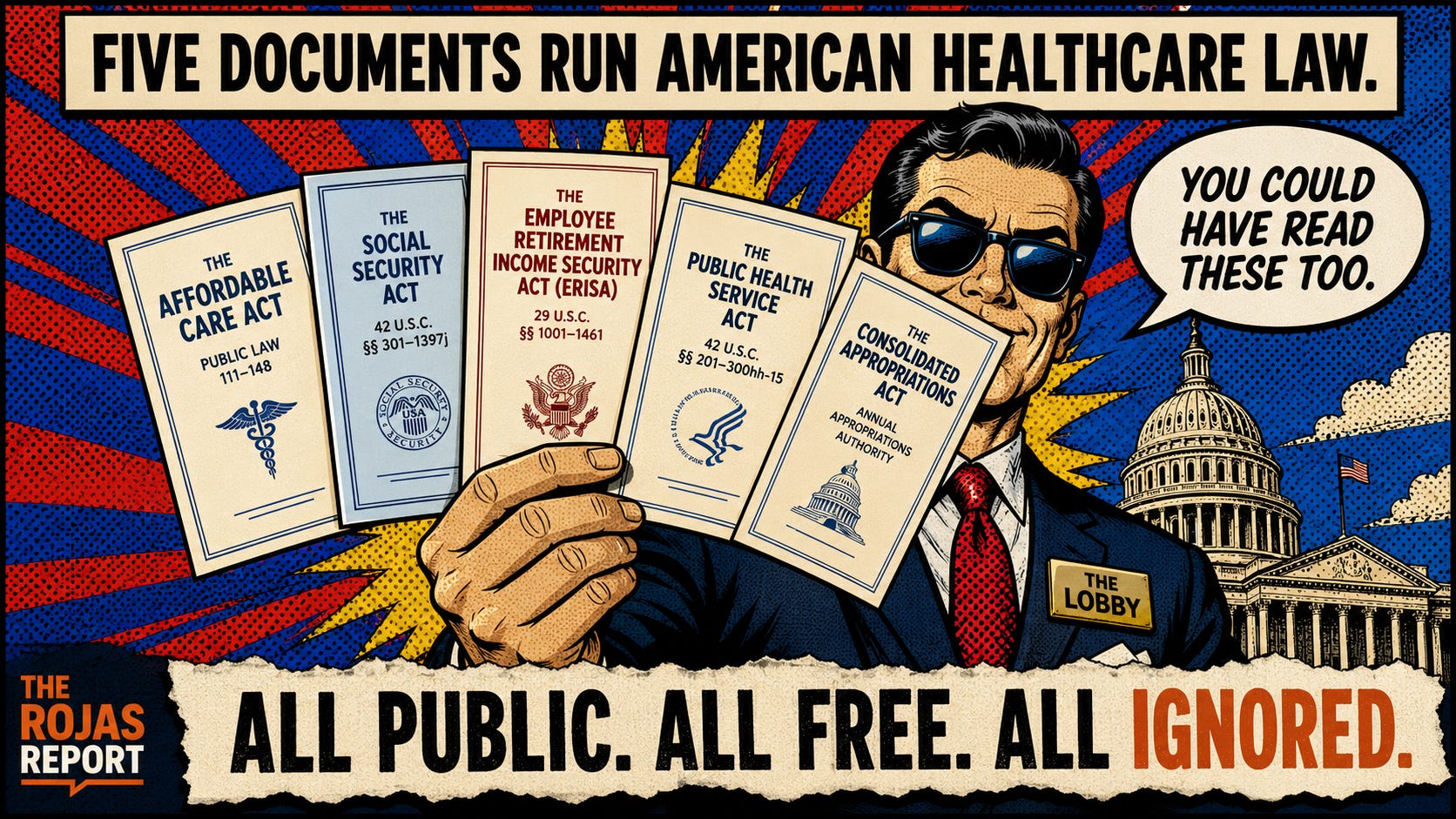
Keyed to this year, all public, all free:
The revised 2026 House calendar, posted since November. The continuing resolution and its December 4 proposed expiration, moving by September 30. The lame-duck manifest, sealed in November, voted in December. The FY2027 reconciliation instructions, $95 billion wide, live now.
And every threshold vote between now and January, read with one question: was this bill brought to the floor to pass, or to fail on camera?
The asymmetry was never information.
It was attention, and attention is a choice.
Now you know where healthcare law actually comes from.
-Rojas out.