
START HERE: HOW THE MACHINE ACTUALLY WORKS
Six mechanisms. Every article on this site runs on one of them.

A 50-person independent practice collects $480,000 less per year than an identical hospital system. Same carrier. Same coverage. Same risk.
Nothing about that gap is accidental. Six mechanisms produce it. Learn them once, and every article here reads differently, including the ones you have already read.
I am Dutch Rojas. Twenty-seven years on the supply and demand side of healthcare. I developed real estate such as ASCs and profesional office buildings, I founded three direct contracting companies, speak around the world on behalf of patients, and have, most recently, deployed capital towards a medical malpractice carrier and a health plan for independent physicians. I sit on the board of Physician-Led Healthcare for America, uncompensated.
ONE: TAX EXEMPTION
The largest hospital systems in America pay no federal income tax, no state income tax, and in most places no property tax. In exchange, they provide community benefit.
They define community benefit themselves.
The IRS deleted the requirement to provide free care in 1969. The tax break survived. What replaced it is a category the hospital fills, measures, and reports on its own Form 990. Free care sits in that bucket next to the gap between what Medicaid paid and what the hospital says its costs were.
Yale New Haven spent 0.69 percent of its expenses on charity care and ended the year with $606 million in cash.
Read: When Did Charity Care Become a Business Strategy · The 25 Most Powerful Nonprofit Health Systems.
TWO: THE BUILDING DECIDES THE PRICE
The same MRI collects two thousand dollars inside a hospital outpatient department and three hundred dollars in the office across the street. Same scan. Same radiologist, sometimes.
The difference is the facility fee, a second charge a hospital collects because the service happened under its roof.
That differential is why hospitals buy practices. Acquisition converts an office into a hospital outpatient department, and the same work starts collecting more the day the sign changes. A remarkable amount of healthcare consolidation is downstream of this one number.
Read: Medicare’s Delayed Approval for Outpatient Joint Replacements
THREE: THE OWNERSHIP CEILING
Federal law caps physician ownership of hospitals at whatever percentage existed on March 23, 2010. Not a ban. A ceiling, frozen on a date.
A physician-owned hospital cannot add beds, add operating rooms, or increase physician ownership above that line. A corporation can buy every surgery center in the state.
The Federation of American Hospitals, the investor-owned hospital lobby, put that provision in the Affordable Care Act. Its president said so on the record in 2021.
Read: Physician-Owned Hospitals · The Paradox of Physician-Owned Hospitals.
FOUR: THE CARRIER SITS BETWEEN YOU AND THE MONEY
You do the work. A carrier decides whether the work gets paid, how much, and when.
Prior authorization, network design, and denial are the instruments. The premium dollar arrives at the carrier first and earns for the carrier while the claim gets adjudicated.
A practice paying $20.5 million in premiums over a decade holds zero equity in the entity that collected it.
Read: $20.5 Million in Premiums. $0 in Equity. · Kaiser: The Denial Comes From Inside the House
Then read the full prosecution of the largest version of this machine: The UnitedHealth Series.
FIVE: THE PRICE IS HIDDEN ON PURPOSE
LASIK posts its price. Since 1998, it became 107 percent more common and half as expensive in real terms, and it got better.
Hospital services went the other direction over the same decades in the same country. One variable differs.
Washington ordered hospitals to post prices starting January 1, 2021. Five years later, CMS had issued 27 fines. The maximum annual penalty equals about 28 minutes of CommonSpirit’s revenue.
Read: Healthcare Isn’t Expensive. It’s Unpriced. · Independence Does Not Cost 50% More
SIX: YOU NEED PERMISSION TO COMPETE
Certificate of need laws operate in 34 states plus DC. Before you build a facility, add beds, or buy a scanner, you file an application proving the community needs it.
The existing hospital gets to file an objection. Sometimes it gets to sit on the reviewing body.
In the states that hold the strongest version of this, a nonprofit system cannot merge without the Attorney General’s written approval. Eight states can block a deal outright. Forty-two get a courtesy notice and a chance to write an opinion while the merger closes.
Entry is a privilege granted by the people already inside.
Read: Certificate of Need Laws · Ohio Can Block Any Nonprofit Hospital Merger. There’s One $6.76 Billion Exception.
WHY THE SIX SURVIVE
Six mechanisms, and not one of them happened on its own.
The Federation of American Hospitals put Section 6001 in the Affordable Care Act. Its president said so on the record. Incumbents lobbied certificate of need into 34 states. Congress set the facility fee differential. The IRS wrote the community benefit standard the industry now grades itself against.
The hospital lobby spent $486 million while physician reimbursement fell for six straight years.
So the mechanisms are not the whole story. This is:
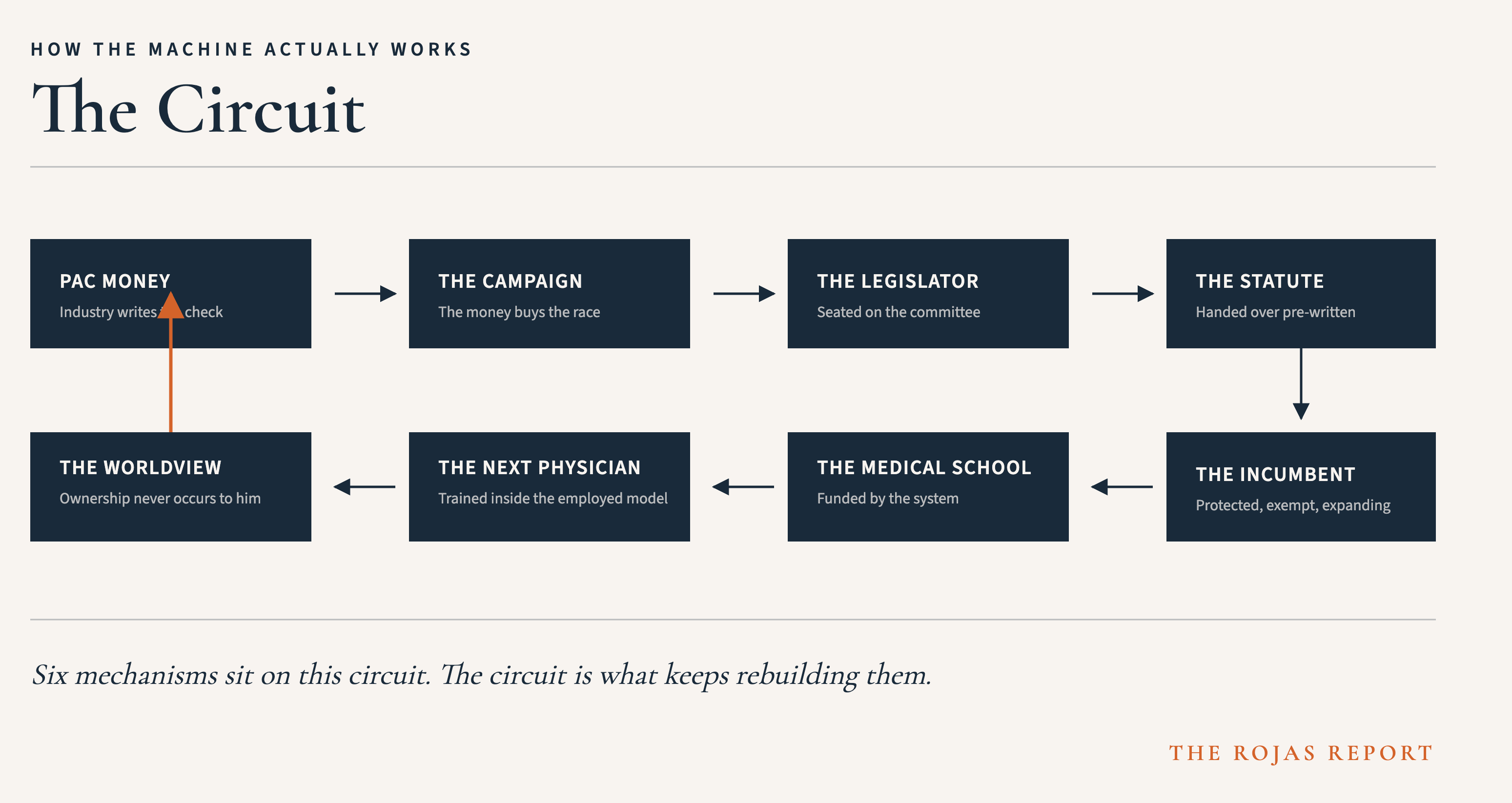
The PAC money funds the campaign. The campaign elects the legislator. The legislator writes the statute. The statute protects the incumbent. The incumbent funds the medical school. The medical school trains the next physician inside the employed model. He never considers ownership, so he never objects.
Most legislation dies of nothing at all. No vote, no veto. It waits in line, and the line closes. Learning to watch that is its own skill.
Read the field manual: How a Bill Really Dies · $486 Million in Lobbying. Six Straight Years of Cuts.
The six sit on that circuit. The circuit is what keeps rebuilding them. That is why healthcare is expensive.
WHAT ELSE IS HERE
Monday through Friday: the prosecution. Named actors, dated receipts.
Saturday: the operator’s manual. Captives, direct contracting, what your practice actually keeps, how the 30 to 45 day cancellation provision in your fully insured contract works.
Sunday: the long view.
Every article opens free. Paid subscribers get the 990 walk-throughs, the PAC trails, the state-by-state breakdowns, and the full archive.
You can learn how the machine works now, or keep finding out at contract renewal. One of those costs less.
100,000 readers a month. Physicians, healthcare executives, and lawmakers.
$300 a year, or $49.95 a month.
-Rojas out.